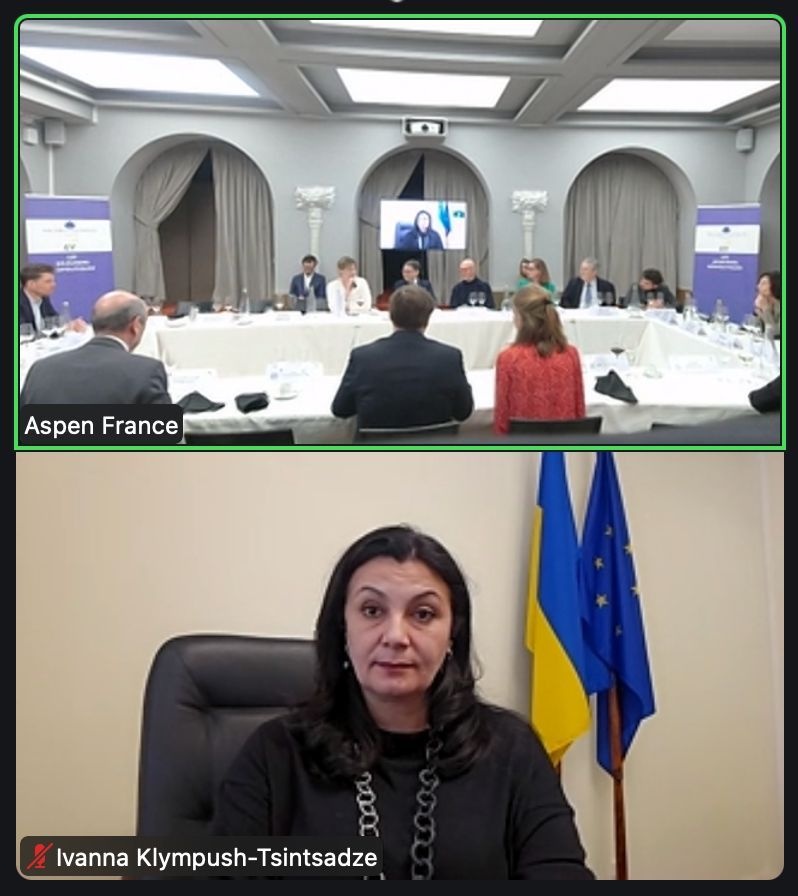
The Chair of the Verkhovna Rada Committee on Ukraine’s Integration into the European Union, Ivanna Klympush-Tsintsadze, emphasized this during a discussion hosted by the Aspen Institute titled “Ukraine, the Day After: Reconstruction and Reconciliation.” The discussion aimed to address the challenges related to Ukraine’s recovery, as well as the complexities of post-war reconciliation.
Ivanna Klympush-Tsintsadze noted that it is extremely difficult to imagine the day after the war while it is still ongoing, with brutal attacks, deaths, and painful losses. “In Kyiv and many cities and villages across Ukraine, people are without electricity for 12 to 14 hours a day, and in some places even longer. This is happening during an exceptionally cold winter. Against the backdrop of another round of negotiations in Geneva, Russia once again attacked Ukraine with waves of drones and ballistic missiles. So when you discuss the first day after the war in Ukraine, it is important to remember that we will not return to the pre-war Ukraine,” the Committee Chair said.
She stressed that despite the tremendous support from the West, there is still no clear and unified position among partners on how to confront Russia in this war in order to protect not only Ukraine but also their own societies. “The United States is currently acting as a mediator between two equal sides pursuing their interests. But these are not equal sides. There is a clear aggressor — Russia — and a victim — Ukraine. Unfortunately, the American side is losing sight of this when it calls for concessions from both sides,” Ivanna Klympush-Tsintsadze said.
She urged partners to remember that Russia is imitating negotiations and buying time, seeking to gain more both through military aggression and through excessive demands at the negotiating table. “They want to fully seize Donbas, erase our national identity, dictate our domestic policy, and close off our Euro-Atlantic future. An unjust peace will not bring security to the European continent. At this moment, Ukraine is the only guarantee that Putin will not invade other countries. Therefore, a well-armed, democratic Ukraine, firmly integrated into European structures, is in Europe’s own interest, not just ours,” she said.
According to her, even conservative estimates suggest that more than €700 billion will be required to rebuild Ukraine. At the same time, reconstruction cannot follow a linear approach focused merely on rebuilding what has been destroyed. “A new economic and industrial model must be created in Ukraine. Reconstruction must take place in parallel with our European integration. It is precisely this process that enables profound, real change and full alignment with the European Union and its principles of democratic governance,” the Committee Chair emphasized. She added that Ukraine can become a strong member of the EU and reinforce the European Union’s role as a major geopolitical actor.
Ivanna Klympush-Tsintsadze also stressed that the world must draw conclusions and learn lessons from this war. In particular, it is important to remember that appeasing an aggressor never leads to peace — it only postpones war. To prevent possible future Russian attacks on other countries, the EU needs, above all, unity and strong pressure on Russia, including through sanctions.
The Chair of the Committee also warned participants that calls for reconciliation after the war are currently too painful and unacceptable for Ukrainians. “Imagine if World War II had not ended with the complete defeat of Nazi Germany — would reconciliation have been possible then? Similarly, now, when there is no discussion of accountability and punishment for Russia’s crimes in this war — what kind of reconciliation can we talk about? This is not possible for us, nor for the generation of our children,” Ivanna Klympush-Tsintsadze said.
She called on European partners to keep Ukraine in focus not only for the sake of Ukrainians, but also for the sake of European security as a whole.
Ivanna Klympush-Tsintsadze noted that it is extremely difficult to imagine the day after the war while it is still ongoing, with brutal attacks, deaths, and painful losses. “In Kyiv and many cities and villages across Ukraine, people are without electricity for 12 to 14 hours a day, and in some places even longer. This is happening during an exceptionally cold winter. Against the backdrop of another round of negotiations in Geneva, Russia once again attacked Ukraine with waves of drones and ballistic missiles. So when you discuss the first day after the war in Ukraine, it is important to remember that we will not return to the pre-war Ukraine,” the Committee Chair said.
She stressed that despite the tremendous support from the West, there is still no clear and unified position among partners on how to confront Russia in this war in order to protect not only Ukraine but also their own societies. “The United States is currently acting as a mediator between two equal sides pursuing their interests. But these are not equal sides. There is a clear aggressor — Russia — and a victim — Ukraine. Unfortunately, the American side is losing sight of this when it calls for concessions from both sides,” Ivanna Klympush-Tsintsadze said.
She urged partners to remember that Russia is imitating negotiations and buying time, seeking to gain more both through military aggression and through excessive demands at the negotiating table. “They want to fully seize Donbas, erase our national identity, dictate our domestic policy, and close off our Euro-Atlantic future. An unjust peace will not bring security to the European continent. At this moment, Ukraine is the only guarantee that Putin will not invade other countries. Therefore, a well-armed, democratic Ukraine, firmly integrated into European structures, is in Europe’s own interest, not just ours,” she said.
According to her, even conservative estimates suggest that more than €700 billion will be required to rebuild Ukraine. At the same time, reconstruction cannot follow a linear approach focused merely on rebuilding what has been destroyed. “A new economic and industrial model must be created in Ukraine. Reconstruction must take place in parallel with our European integration. It is precisely this process that enables profound, real change and full alignment with the European Union and its principles of democratic governance,” the Committee Chair emphasized. She added that Ukraine can become a strong member of the EU and reinforce the European Union’s role as a major geopolitical actor.
Ivanna Klympush-Tsintsadze also stressed that the world must draw conclusions and learn lessons from this war. In particular, it is important to remember that appeasing an aggressor never leads to peace — it only postpones war. To prevent possible future Russian attacks on other countries, the EU needs, above all, unity and strong pressure on Russia, including through sanctions.
The Chair of the Committee also warned participants that calls for reconciliation after the war are currently too painful and unacceptable for Ukrainians. “Imagine if World War II had not ended with the complete defeat of Nazi Germany — would reconciliation have been possible then? Similarly, now, when there is no discussion of accountability and punishment for Russia’s crimes in this war — what kind of reconciliation can we talk about? This is not possible for us, nor for the generation of our children,” Ivanna Klympush-Tsintsadze said.
She called on European partners to keep Ukraine in focus not only for the sake of Ukrainians, but also for the sake of European security as a whole.
More posts by topic
“News”
16 September 2026 12:00
20 April 2026 10:15
16 April 2026 13:30
09 April 2026 11:01
07 April 2026 11:34
24 February 2026 10:38
19 February 2026 10:33
11 February 2026 10:31
09 February 2026 10:29
06 February 2026 10:25