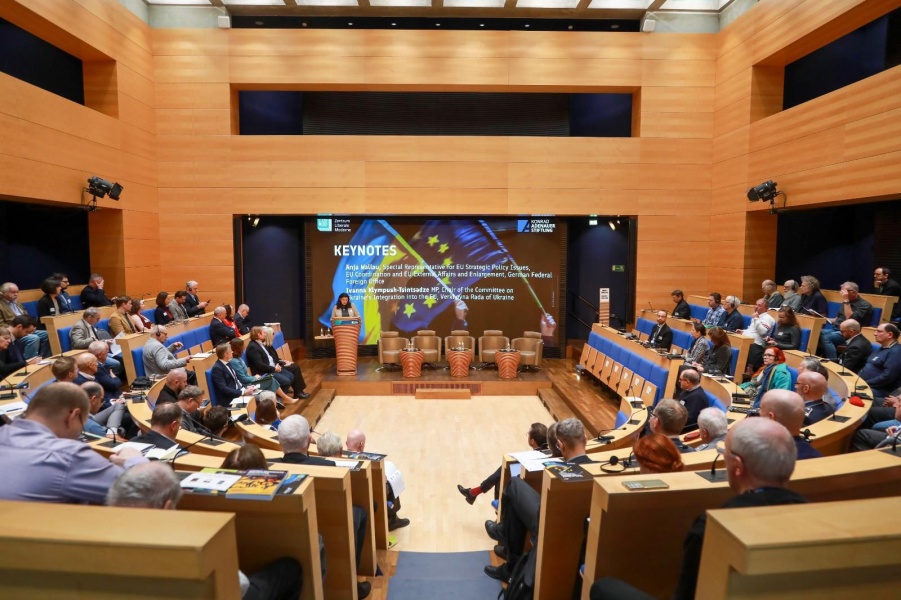
Ivanna Klympush-Tsintsadze, Chair of the Committee on Ukraine’s Integration into the EU, took part in the conference “Geopolitical Turning Point? Ukraine and the Future of the European Union” held in Berlin. The event was organised by the Konrad Adenauer Foundation and Zentrum Liberale Moderne. Ivanna Klympush-Tsintsadze delivered a keynote address to the participants and contributed to a session dedicated to Ukraine’s accession to the EU, where discussions focused on Ukraine’s progress toward the Union, the obstacles that must be removed, and the challenges that must be overcome.
The Chair noted that speaking about the future in Europe while Ukraine pays a bloody price for freedom every day, and at the same time continues to be shaken by new corruption scandals, is a difficult challenge. But it is also a reminder that even during war, one cannot betray the very principles Ukraine is fighting for. “I am grateful to civil society, grateful to our partners for not remaining silent when the authorities attempted to dismantle the anti-corruption institutions, because today we see the results of their work,” Ivanna Klympush-Tsintsadze said.
She stressed that, in addition to judicial and procedural decisions, tough political decisions are needed as well as a complete reset of the government. “And an actual restoration of Parliament’s powers in terms of its institutional agency, clear oversight and scrutiny of the government. Because Parliament has always played an important and serious role in Ukraine’s history,” the Chair emphasised.
Ivanna Klympush-Tsintsadze noted that despite the overall positive Enlargement Report recently published by the European Commission, Ukraine must honestly acknowledge that the pace of reforms has slowed. “We are seriously falling behind Moldova, and a number of the EU’s recommendations, particularly in such crucial areas as the rule of law, the judiciary, and anti-corruption, remain unfulfilled. The summer attempts to strip anti-corruption bodies of their independence did not go unnoticed by our partners, which is also reflected in the Report. And it is good that Ukrainian society firmly set red lines,” she stated.
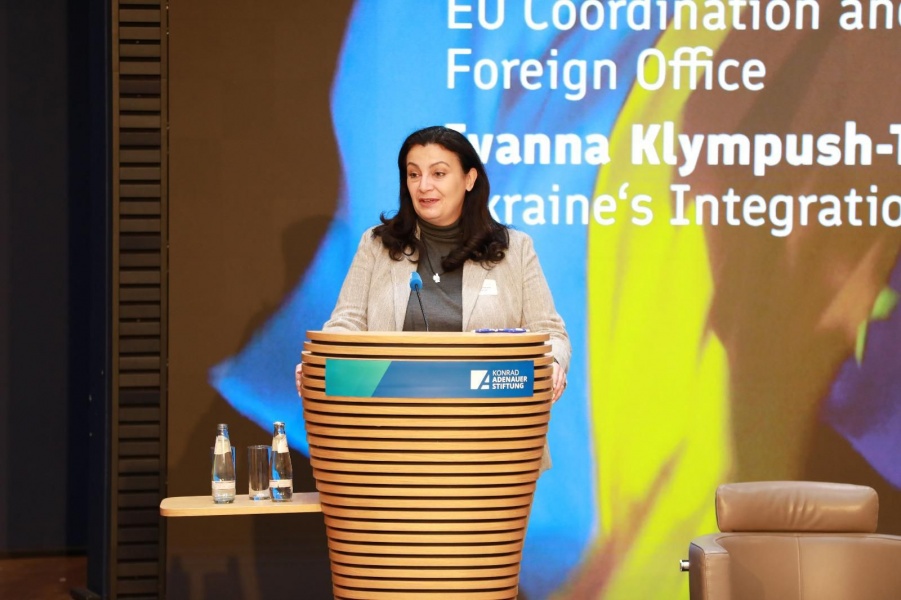
She also insisted that political determination is required from the European Union itself. The EU enlargement process cannot remain hostage to bureaucracy or national vetoes that some leaders, such as Orbán, use to promote Kremlin narratives. Therefore, the decision-making principle in the EU, at least regarding the opening of clusters, needs immediate revision. “Such indecision and the reluctance to take geopolitical steps demotivates Ukrainians who are literally fighting with their lives not only for the right to exist but also for a better future in the family of European nations who believe that Europe is a space of freedom and peace, and a space capable of ensuring peace institutionally,” Ivanna Klympush-Tsintsadze said.
She stressed that Ukraine’s European choice is a civilisational choice. “Seventy-four percent of our citizens firmly believe that European integration is the only path to our future. We believe in a Europe of values — freedom, justice, the rule of law. This belief may seem naïve, but it is precisely what helped us stand on the Maidans and helps us move forward today,” she added.
The Chair reminded participants that Ukrainians have repeatedly shown they are capable of achieving the impossible. Today, despite all difficulties and the slowdown in pace, Ukraine continues to do its homework on the road to the EU. “I recalled the posters of revolutionary Paris in 1968: ‘Be idealists, demand the impossible.’ For Ukraine this call sounds different today: ‘Let us be pragmatic and accomplish the impossible’ — and then we will inevitably become part of the European Union,” concluded the Chair of the Committee on Ukraine’s Integration into the EU.
The Chair noted that speaking about the future in Europe while Ukraine pays a bloody price for freedom every day, and at the same time continues to be shaken by new corruption scandals, is a difficult challenge. But it is also a reminder that even during war, one cannot betray the very principles Ukraine is fighting for. “I am grateful to civil society, grateful to our partners for not remaining silent when the authorities attempted to dismantle the anti-corruption institutions, because today we see the results of their work,” Ivanna Klympush-Tsintsadze said.
She stressed that, in addition to judicial and procedural decisions, tough political decisions are needed as well as a complete reset of the government. “And an actual restoration of Parliament’s powers in terms of its institutional agency, clear oversight and scrutiny of the government. Because Parliament has always played an important and serious role in Ukraine’s history,” the Chair emphasised.
Ivanna Klympush-Tsintsadze noted that despite the overall positive Enlargement Report recently published by the European Commission, Ukraine must honestly acknowledge that the pace of reforms has slowed. “We are seriously falling behind Moldova, and a number of the EU’s recommendations, particularly in such crucial areas as the rule of law, the judiciary, and anti-corruption, remain unfulfilled. The summer attempts to strip anti-corruption bodies of their independence did not go unnoticed by our partners, which is also reflected in the Report. And it is good that Ukrainian society firmly set red lines,” she stated.
She also insisted that political determination is required from the European Union itself. The EU enlargement process cannot remain hostage to bureaucracy or national vetoes that some leaders, such as Orbán, use to promote Kremlin narratives. Therefore, the decision-making principle in the EU, at least regarding the opening of clusters, needs immediate revision. “Such indecision and the reluctance to take geopolitical steps demotivates Ukrainians who are literally fighting with their lives not only for the right to exist but also for a better future in the family of European nations who believe that Europe is a space of freedom and peace, and a space capable of ensuring peace institutionally,” Ivanna Klympush-Tsintsadze said.
She stressed that Ukraine’s European choice is a civilisational choice. “Seventy-four percent of our citizens firmly believe that European integration is the only path to our future. We believe in a Europe of values — freedom, justice, the rule of law. This belief may seem naïve, but it is precisely what helped us stand on the Maidans and helps us move forward today,” she added.
The Chair reminded participants that Ukrainians have repeatedly shown they are capable of achieving the impossible. Today, despite all difficulties and the slowdown in pace, Ukraine continues to do its homework on the road to the EU. “I recalled the posters of revolutionary Paris in 1968: ‘Be idealists, demand the impossible.’ For Ukraine this call sounds different today: ‘Let us be pragmatic and accomplish the impossible’ — and then we will inevitably become part of the European Union,” concluded the Chair of the Committee on Ukraine’s Integration into the EU.
More posts by topic
“News”
16 September 2026 12:00
20 April 2026 10:15
16 April 2026 13:30
09 April 2026 11:01
07 April 2026 11:34
24 February 2026 10:38
19 February 2026 10:33
11 February 2026 10:31
09 February 2026 10:29
06 February 2026 10:25